
A skincare favorite doesn’t automatically make a toothpaste a proven whitener. Niacinamide toothpaste may catch your eye because the ingredient is familiar and the product promises a brighter smile. But niacinamide itself isn’t the main ingredient to rely on for removing tooth stains.
It’s reasonable to wonder what it can really do. Social posts and product claims can blur the line between a promising ingredient and a proven result, especially when niacinamide is better known from skincare. Its role in toothpaste may include potential gum-support benefits, but whitening depends more on the complete formula and how it addresses surface stains.
This guide separates what the evidence supports from what a product name or headline claim can’t prove. You’ll learn how to assess whitening ingredients, why the full label matters, and what to consider in an everyday toothpaste, including UTOGRU Niacinamide Whitening Toothpaste. The goal is to help you choose a product that fits your routine without expecting one highlighted ingredient to do it all.
Key Takeaways
- Niacinamide is a form of vitamin B3, but its presence in toothpaste doesn’t prove a specific dental benefit.
- Assess niacinamide toothpaste by its full formula and evidence, not the ingredient name or whitening promise alone.
- Compare fluoride information, the whitening approach, package directions, and available evidence before choosing a toothpaste.
- Follow the product label and keep your routine steady so you can assess results realistically.
- Explore UTOGRU Niacinamide Whitening Toothpaste as one option, while keeping your specific dental needs in mind.
Niacinamide Toothpaste: What It Is and Why It Is Trending
Can a toothpaste ingredient known from skincare make teeth look brighter, or is the name doing most of the work? Start by separating what niacinamide is from what a finished toothpaste has been shown to do. The ingredient’s identity is clear, but its dental benefits depend on evidence about its use in toothpaste.
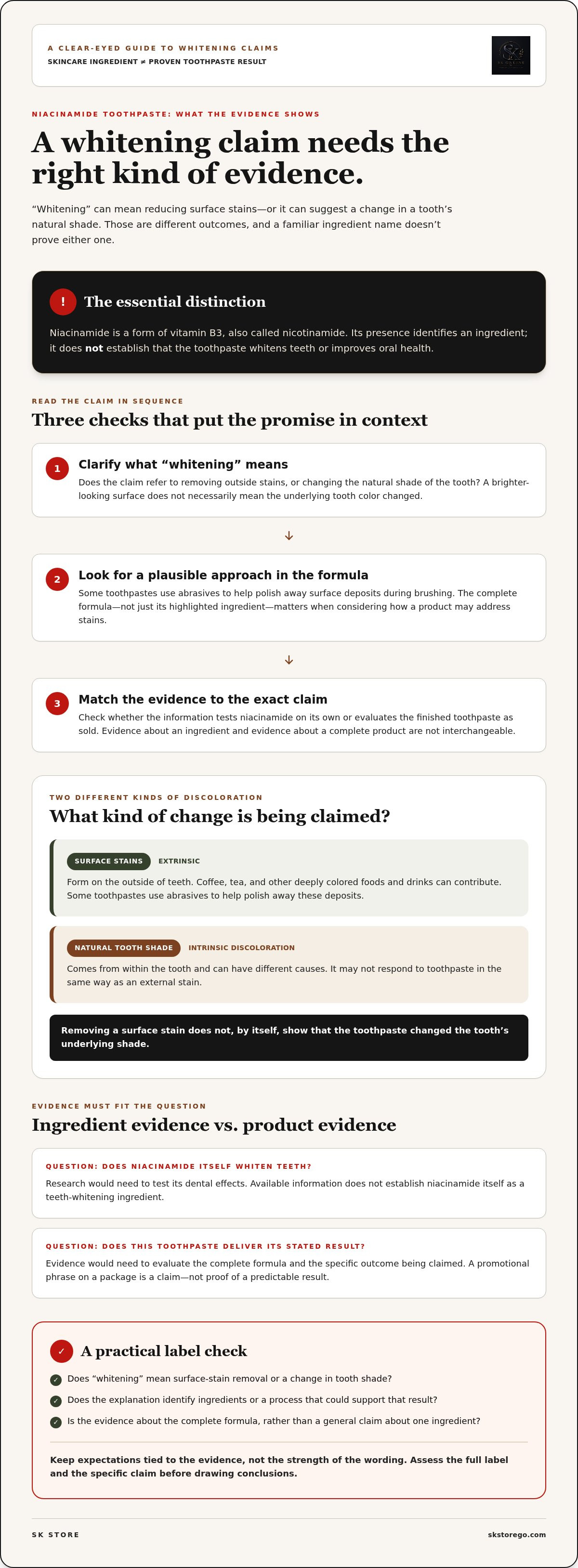
Niacinamide is a form of vitamin B3; its presence in toothpaste identifies an ingredient, not proof that the product whitens teeth or improves oral health. Keep that distinction in mind when you read claims. It lets you consider new formulas without treating a familiar name or a confident package promise as a guaranteed result.
What is niacinamide in a toothpaste?
Niacinamide is the name for a form of vitamin B3, also called nicotinamide. In toothpaste, it is one component of a formulated product, not a standalone treatment. Its use in skincare doesn’t establish that it works the same way on teeth or in the mouth.
A toothpaste’s effects depend on the whole formula, including the ingredients, their amounts, and how the product is intended to be used. Claims also need relevant supporting evidence. The ingredient name alone can’t tell you whether a particular toothpaste will deliver a noticeable change. Avoid assuming a dental mechanism or outcome based only on niacinamide’s role in another type of product.
Why are shoppers searching for niacinamide toothpaste?
Beauty conversations travel quickly. When a familiar skincare ingredient appears in a new category, social posts and product listings can make it feel like an obvious addition to a daily routine. That crossover invites curiosity, especially for shoppers looking for a straightforward way to care for their smile.
Attention isn’t the same as clinical proof. A trending ingredient may prompt you to explore a product, but it can’t establish how well that product works. For niacinamide toothpaste, look past the headline and consider what the specific claim means, what evidence supports it, and what the complete label says. A promise to “brighten” may refer to surface-stain removal, for example, rather than changing the natural shade of teeth. The wording matters.
A practical first read is simple: identify the benefit being claimed, then see whether the package explains how the formula is meant to support it. Check the full ingredient list and directions instead of judging by a highlighted ingredient or a social-media recommendation. If the evidence isn’t clear, keep your expectations modest. That’s a useful standard whether you’re comparing options or considering UTOGRU Niacinamide Whitening Toothpaste for your routine. Next, look at what whitening claims can and can’t tell you.
Can Niacinamide Toothpaste Whiten Teeth? What the Evidence Shows
The answer depends on what “whiten” means. Toothpaste may help reduce some surface stains, but that’s different from changing the natural shade of a tooth. A claim that a formula brightens a smile shouldn’t be taken as proof that niacinamide itself causes the effect.
Surface stains versus intrinsic tooth color
Surface, or extrinsic, stains form on the outside of teeth. Coffee, tea, and other deeply colored foods and drinks can contribute to them. Some toothpastes use abrasives to help polish away these deposits during brushing, so the visible result may be a cleaner-looking surface.
Intrinsic discoloration comes from within the tooth and can have different causes. It may not respond to toothpaste in the same way as an external stain. A product that helps remove surface discoloration hasn’t necessarily changed the underlying tooth shade. Don’t treat “whitening” as one specific outcome unless the claim explains what kind of change is meant.
What can shoppers conclude from current claims?
Evidence about an ingredient and evidence about a finished product are not interchangeable. To show that niacinamide itself whitens teeth, research would need to test its dental effects. To support a claim for a particular toothpaste, evidence would need to evaluate that complete formula and the stated outcome. A promotional phrase on a package is a claim, not proof of a predictable result.
Available information does not establish that niacinamide itself whitens teeth; whether a specific toothpaste removes surface stains depends on its full formulation, and its product-level results need relevant supporting evidence. That’s a cautious reading, not a declaration that every formula performs the same way. Ingredients such as abrasives may contribute to stain removal, while a highlighted ingredient’s presence alone can’t tell you what to expect.
Some coverage of this trend includes dentists’ skepticism about whitening promises. That’s useful context, but skepticism isn’t a settled verdict on every finished product. Look for evidence that matches the exact claim: surface-stain removal, a change in natural tooth shade, or another benefit. Also note whether the information tests niacinamide on its own or the toothpaste as sold. Those aren’t interchangeable.
For a quick label check, ask yourself:
- Does “whitening” refer to surface stains or a change in tooth shade?
- Does the explanation identify ingredients or a process that could support the stated result?
- Is the evidence about this complete formula, rather than a general claim about one ingredient?
Keep expectations tied to the evidence, not the strength of the wording. If you’re considering an ingredient-led option, you can explore UTOGRU Niacinamide Whitening Toothpaste and assess its label and claims. Next, compare those details with other whitening toothpaste features.
How to Compare Niacinamide Toothpaste with Other Whitening Toothpastes
A useful comparison starts with the whole label, not the ingredient featured most prominently on the front. Check what the toothpaste claims to do, which ingredients and directions appear on the package, and what evidence supports the stated result. The framework below helps you compare products without assuming similar “whitening” language means they work in the same way.
| What to compare | What to look for | What it can tell you |
|---|---|---|
| Niacinamide claim | Whether the label names a specific benefit and explains its basis | Ingredient presence alone doesn’t show its concentration or prove a dental effect. |
| Fluoride information | Whether fluoride appears on the current label, and what the package says about it | Don’t assume fluoride status or cavity-prevention benefits from the product name. |
| Whitening approach | Whether the product describes stain removal, color correction, or another approach | Different methods target different visible effects, so the wording matters. |
| Directions and warnings | How the package says to use the toothpaste and any cautions | The directions help you understand intended use and relevant precautions. |
| Evidence | Whether support relates to the ingredient or the finished formula | Product-level evidence is more relevant to a claim about that specific toothpaste. |
Which label details matter beyond niacinamide?
Read the full ingredient list and package directions, then check any listed active ingredients, fluoride information, and relevant warnings. Ingredient order or presence alone may not tell you an ingredient’s concentration, and concentration by itself doesn’t establish effectiveness. Compare the product’s packaging and product information with the benefit being advertised. If a claim mentions enamel, gums, or cavity prevention, look for clear wording that supports that particular benefit rather than treating it as part of “whitening.”
How do whitening approaches differ?
Some whitening toothpastes focus on polishing or removing surface stains. Peroxide-based whitening products use a different approach, and their claims should be assessed according to the product, directions, and intended result. Purple toothpaste is different again: it is generally presented as a color-correcting approach, not the same claim as removing stains. No method should be ranked without considering the outcome claimed and the evidence that supports it.
For niacinamide toothpaste, ask whether the whitening claim is tied to the whole formula or simply highlights niacinamide. A gum-support statement is not automatically evidence of tooth whitening, just as a fluoride statement does not explain a stain-removal approach. Keep those benefits distinct as you compare labels.
Sk Store also carries Purple Teeth Whitening Toothpaste, a separate option to consider when comparing approaches. For any product, let the package guide your expectations: review its ingredients, fluoride information, directions, and stated evidence instead of relying on a category name or a familiar ingredient alone.
How to Use Niacinamide Toothpaste with Realistic Expectations
A new toothpaste is easiest to assess when you keep the routine simple. Follow the directions on its packaging, leave your other oral-care habits steady, and give yourself a fair way to notice how your mouth feels and looks. No toothpaste can promise an overnight change, and a whitening result isn’t guaranteed.
A simple, label-led routine
Use the product as directed rather than assuming every toothpaste has identical instructions. The package takes priority over generic advice, especially if it includes specific directions or warnings. Don’t use it more often or in a different way than the label recommends.
- Read the package. Check the directions, ingredients, fluoride information, and any warnings before adding the toothpaste to your routine.
- Follow the stated use. Use the toothpaste according to its label. Don’t increase use in an effort to speed up whitening.
- Keep other habits consistent. Avoid introducing several new whitening products at the same time. If you change toothpaste, add a whitening pen, and alter another part of your routine together, it can be hard to tell what caused a change or discomfort.
- Assess the result calmly. Notice whether you see a change in surface staining or simply prefer how your teeth feel. Don’t treat a lack of immediate visible whitening as a reason to exceed the directions.
With niacinamide toothpaste, the ingredient name alone can’t tell you how quickly you’ll see a difference, or whether you will. Results depend on the full formula and the kind of change the product claims to support. If you’re comparing options, focus on the packaging and realistic outcomes, not promises of a perfect shade.
What if sensitivity or irritation occurs?
If the toothpaste causes discomfort, stop using it and review the product directions and warnings. Don’t assume niacinamide prevents sensitivity or that discomfort is something you need to push through. If sensitivity or pain persists, worsens, or comes with another oral-health concern, seek advice from a dental professional.
It also helps to distinguish a temporary impression from a dependable result. Lighting, recent food or drink, and day-to-day variation can affect how teeth appear. Keep your expectations measured, and don’t add extra whitening steps just because you want faster progress. A steady, label-led routine makes it easier to evaluate a product without adding unnecessary variables.
Ready to make one considered change to your routine? Explore UTOGRU Niacinamide Whitening Toothpaste and use its label to guide how you incorporate it.
Is UTOGRU Niacinamide Whitening Toothpaste a Fit for Your Routine?
UTOGRU Niacinamide Whitening Toothpaste is an option for shoppers curious about an ingredient-led approach to everyday oral care. Its name tells you which ingredient is highlighted, but it doesn’t establish what the full formula contains or what results to expect. A good fit depends on your priorities and the product information, not the name alone.
Who may want to explore this toothpaste?
You may be interested if you enjoy learning about ingredients and want to compare a niacinamide toothpaste with other everyday options. Treat that curiosity as a starting point. Before deciding, look at the package for the full ingredient list, fluoride information, directions, warnings, and the exact benefits claimed. Each detail can help you understand whether the product aligns with what you’re looking for.
Keep the intended result in view, too. If your priority is surface-stain removal, look for a clear whitening claim and evidence that supports it. If you’re choosing toothpaste based on cavity prevention or another specific dental need, prioritize information relevant to that need instead of assuming the highlighted ingredient addresses it. No one formula is automatically right for everyone, and a product name can’t predict how an individual will respond.
Separate a general ingredient story from product-specific support. A benefit attributed to niacinamide in another context doesn’t verify the same benefit in toothpaste. Look for claims that refer to the finished formula, and keep your expectations measured if the packaging doesn’t explain the evidence or intended outcome clearly.
A confident next step
Use three checks to make the choice feel simpler:
- Realistic claim: Identify the specific outcome promised, such as surface-stain removal, and avoid reading more into the wording than it says.
- Complete formula: Review the full ingredient list and fluoride information instead of focusing only on niacinamide.
- Clear directions: Make sure the package explains how to use the product and includes any relevant warnings.
If sensitivity is part of your decision, don’t assume a whitening toothpaste will be comfortable simply because it sounds gentle. Check the product details and consider how the formula fits your needs. A sensitivity-focused whitening guide can also help you compare broader options, but persistent discomfort or a specific dental concern deserves professional dental advice.
If the label and claims suit your priorities, UTOGRU Niacinamide Whitening Toothpaste is one option to consider for your routine. Review its product information and decide whether its stated benefits match what you’re looking for.
Make Your Next Choice with Confidence
Your everyday routine doesn’t need a trend-driven upgrade to feel intentional. Choose a toothpaste by how its stated benefits fit your priorities, and don’t expect a single ingredient to transform your smile. A thoughtful choice is one you understand and feel comfortable using as directed.
If you’re curious about niacinamide toothpaste, let that curiosity guide a closer look, not set a result you have to achieve. Review the product information, consider what matters most in your routine, and keep your expectations grounded. Sk Store offers UTOGRU Niacinamide Whitening Toothpaste as one option to explore among its beauty and personal-care products.
Explore UTOGRU Niacinamide Whitening Toothpaste at Sk Store and choose with a clearer sense of what it claims and what you can reasonably expect.
Frequently Asked Questions
Is niacinamide the same as nicotinamide?
Yes. Niacinamide and nicotinamide are names for the same form of vitamin B3. That tells you what the ingredient is, not what it will do in toothpaste. Oral-care effects depend on the finished product and evidence relevant to its use. Skincare findings don’t automatically apply to teeth, gums, or the mouth, so assess toothpaste claims on their own instead of transferring expectations from a face cream or serum.
Can niacinamide toothpaste replace fluoride toothpaste?
Don’t assume it can. Niacinamide and fluoride are different ingredients, and a niacinamide claim doesn’t tell you whether the formula contains fluoride. Check the product label for fluoride information. If cavity prevention is a priority, ask a dental professional which toothpaste suits your needs instead of relying on a whitening claim. This is especially useful if you’re choosing a new toothpaste for a specific reason, not simply comparing ingredient trends.
Does niacinamide toothpaste whiten crowns, veneers, or fillings?
No toothpaste changes the underlying shade of crowns, veneers, or fillings in the same way a whitening treatment may affect natural teeth. Depending on its formula, toothpaste may help clean surface deposits, but that doesn’t change the restoration’s material color, and results can vary. If a crown or veneer looks stained or mismatched beside your natural teeth, get dental advice before trying stronger whitening products or a more abrasive routine.
What happens if I accidentally swallow a small amount of toothpaste?
A small accidental swallow is different from intentionally eating toothpaste, but the amount and ingredients matter. Rinse your mouth and follow the product label. If someone swallows a larger amount, develops symptoms, or is a child, contact a local poison-control service for guidance. Keep toothpaste out of young children’s reach, and store it where it won’t be mistaken for food or a treat.
How much niacinamide toothpaste should I use?
Use the amount and frequency stated on the product’s packaging. There isn’t a universal amount based on the niacinamide name, and using extra won’t guarantee faster whitening. For children, check age-specific directions rather than applying adult assumptions. If you’re unsure how a toothpaste fits a dental condition or a child’s routine, ask a dental professional for guidance before changing how it’s used.
Can I use niacinamide toothpaste with whitening strips?
It depends on the toothpaste formula and the strip instructions. Read both labels, follow each product’s directions, and don’t increase use or wear time to chase a quicker result. Combining products doesn’t guarantee faster whitening. If you have sensitive teeth, existing dental work, or ongoing oral discomfort, seek dental guidance before pairing them. Stop using a product if it causes discomfort, and review its label before deciding what to do next.