

The strongest-sounding teeth whitening toothpaste isn’t automatically the right one for your routine. A formula aimed at surface stains may not change deeper discoloration, and a product that doesn’t feel comfortable may be difficult to use consistently.
With different formulas, formats, and bold claims to compare, start with what you want the product to do. Most whitening toothpastes focus on surface stains, so they may not change a tooth’s underlying colour. The best choice is one that matches your expectations, daily-care priorities, and comfort level.
This guide compares common whitening approaches, explains what toothpaste can and can’t do, and outlines practical details to consider if sensitivity is on your mind. You’ll also see how Sk Store’s UTOGRU Niacinamide Whitening Toothpaste and Purple Teeth Whitening Toothpaste fit into a thoughtful comparison. Use a few simple criteria to narrow your choices and find an option that feels manageable in your everyday routine.
Key Takeaways
- Set realistic expectations by matching your whitening goal to the kind of discoloration a toothpaste is intended to address.
- Compare teeth whitening toothpaste by its stated approach, sensitivity considerations, and fit with your everyday care routine.
- Use a simple checklist to weigh product claims, directions, and routine fit before choosing a formula.
- Keep toothpaste, pens, and strips distinct when comparing at-home whitening formats; they aren’t interchangeable.
- Compare Sk Store’s UTOGRU Niacinamide Whitening Toothpaste and Purple Teeth Whitening Toothpaste by their stated positioning and your personal priorities.
What teeth whitening toothpaste can realistically do for your smile
Whitening toothpaste is a brushing formula designed to help reduce surface stains or make teeth look brighter. Unlike whitening pens, strips, or trays, it’s used as part of regular brushing rather than applied as a separate treatment. Ingredients and directions vary, so the likely effect depends on the formula and the type of discoloration it is intended to address.
Whitening toothpaste is designed to help clean away or reduce certain stains on the tooth surface, not to guarantee a change to the tooth’s natural shade. Keep that distinction in mind when setting a realistic goal and comparing products.
Surface stains and natural tooth colour are not the same
Coffee, tea, and tobacco can contribute to stains on the outer tooth surface. These are often called extrinsic stains. Discoloration can also come from within a tooth, sometimes described as intrinsic discoloration. Because the causes differ, toothpaste may not affect both in the same way. This general overview of Tooth whitening explains how whitening approaches and stain types vary.
You don’t need to identify the cause yourself to compare products. It’s useful to know that reducing surface staining isn’t the same as changing the underlying colour of a tooth. If a change in colour is new or concerning, a dental professional can help assess it.
What to expect from toothpaste in an everyday routine
Think of toothpaste as one part of consistent oral care, not a one-time whitening treatment. Some formulas use polishing ingredients to help remove surface stains during brushing; other products or ingredients may work differently. The specific formula matters, and an ingredient name alone doesn’t establish how effective or suitable a product will be for you.
Follow the toothpaste directions and your usual oral-care guidance. Don’t use more or brush for longer than the label recommends in pursuit of faster results. If a formula feels uncomfortable, stop using it and seek dental guidance, especially if sensitivity persists. A routine should feel manageable, not like a test of endurance.
To compare a specific ingredient with care, explore this niacinamide toothpaste evidence and selection guide. It can help you look beyond a headline claim and consider what the product description says. With any teeth whitening toothpaste, let its stated purpose, directions, and your comfort guide your expectations. A steady routine and a realistic goal are a better starting point than promises of an overnight shade change.
How whitening toothpaste works: ingredients, stain type, and realistic limits
Whitening formulas don’t all work the same way. Some rely on polishing ingredients, such as mild abrasives, to help lift stains from the tooth surface during brushing. Others may use chemical ingredients to help break down stains. The product label can describe its approach, but the formula, directions, and type of discoloration all shape what a reasonable result might look like.
The American Dental Association explains that whitening toothpastes mainly address surface stains, while peroxide bleaching products can change tooth colour. Its guidance on tooth whitening offers more detail on whitening methods and considerations such as sensitivity.
How to read whitening claims and ingredient descriptions
A product description tells you what a brand says the formula is intended to do. An ingredient list tells you what’s in it. Neither, by itself, shows how much whitening a person will experience. Look for claims that identify the intended target, such as surface stains, and read them alongside the full directions. Don’t assume a bold phrase applies to every kind of discoloration.
Hydrogen peroxide and carbamide peroxide are used in some bleaching products, but their presence shouldn’t be assumed in every toothpaste. An ingredient name alone also doesn’t tell you a product’s strength, contact time, performance, or suitability for sensitive teeth. A teeth whitening toothpaste may instead focus on polishing surface stains, so compare the formula’s stated purpose with the result you want.
When a toothpaste may not match the concern
If discoloration comes from within a tooth rather than from surface staining, a polishing approach may not create the change you expect. The difference isn’t always obvious from appearance alone, and this article can’t identify the cause for you. Treat whitening claims as product-specific, not as a promise of a particular shade or outcome.
Consistency matters, too. Toothpaste is used during regular brushing, and each product’s directions are designed for that formula. Follow the label and normal oral-care guidance rather than brushing longer or using more in hopes of speeding up a result. If you have persistent concerns or notice a significant change in tooth colour, ask a dental professional for advice before choosing a whitening approach.
As you compare options, weigh the stated stain target, ingredients, directions, and your comfort rather than relying on a single headline claim. To browse oral-care choices, explore Sk Store’s best sellers and use those same practical criteria as you consider what fits your routine.
Compare whitening toothpaste by sensitivity, formula, and daily-use fit
A useful comparison starts with your everyday needs, not the boldest promise on the package. Decide whether you want toothpaste for regular brushing, a product intended for targeted touch-ups, or a different format. Then weigh its stated purpose against your comfort and usual oral-care priorities. Keeping the formats distinct makes it easier to choose a routine you can stick with.
| Option | Stated positioning | Daily-use fit and reader priority |
|---|---|---|
| UTOGRU Niacinamide Whitening Toothpaste | Niacinamide; fluoride-free positioning | Compare its stated features with your regular-care needs. Fluoride-free positioning alone doesn’t establish greater safety or cavity protection. |
| Purple Teeth Whitening Toothpaste | Purple formula intended for daily brushing and a brighter-looking smile | Consider whether a toothpaste for everyday brushing suits the routine you want. |
| Teeth whitening pen | Sk Store’s option is a mint gel product for targeted touch-ups | A separate format from toothpaste; consider it if targeted application is your priority. |
| Whitening strips | Adhesive strips are a separate at-home format | Consider their distinct application and directions rather than treating them as brushing toothpaste. |
Choosing with sensitivity and everyday oral care in mind
If you already experience ongoing sensitivity, comfort deserves as much attention as whitening claims. A formula described as gentle or low sensitivity isn’t a guarantee that it will suit everyone. If use causes persistent discomfort, stop using the product and seek advice from a dental professional. Professional guidance can also help align whitening choices with your broader oral-care needs instead of focusing on appearance alone.
Check the directions and the product’s full positioning before adding it to your routine. For example, fluoride-free describes a formulation feature; it doesn’t, by itself, prove a toothpaste is safer or provides cavity protection. Choose based on what your daily care requires, and follow relevant professional guidance.
Toothpaste versus pens and strips
Toothpaste is used with a toothbrush as part of brushing. A pen or strip is a separate whitening format with its own application method and directions, so it shouldn’t be treated as an interchangeable version of toothpaste. Sk Store offers the Teeth Whitening Pen - Low Sensitivity Gel, Mint (Pack of 2), a mint gel product for targeted touch-ups. That description identifies its format and positioning, but doesn’t promise a particular result or guarantee comfort for everyone.
When comparing teeth whitening toothpaste with other formats, consider what you’ll realistically use: a brushing product that fits your everyday routine, or a separately applied option with its own instructions. Keep comfort and basic oral-care priorities in view, and follow the directions for whichever format you choose. A practical fit is more useful than choosing a product based on one feature alone.
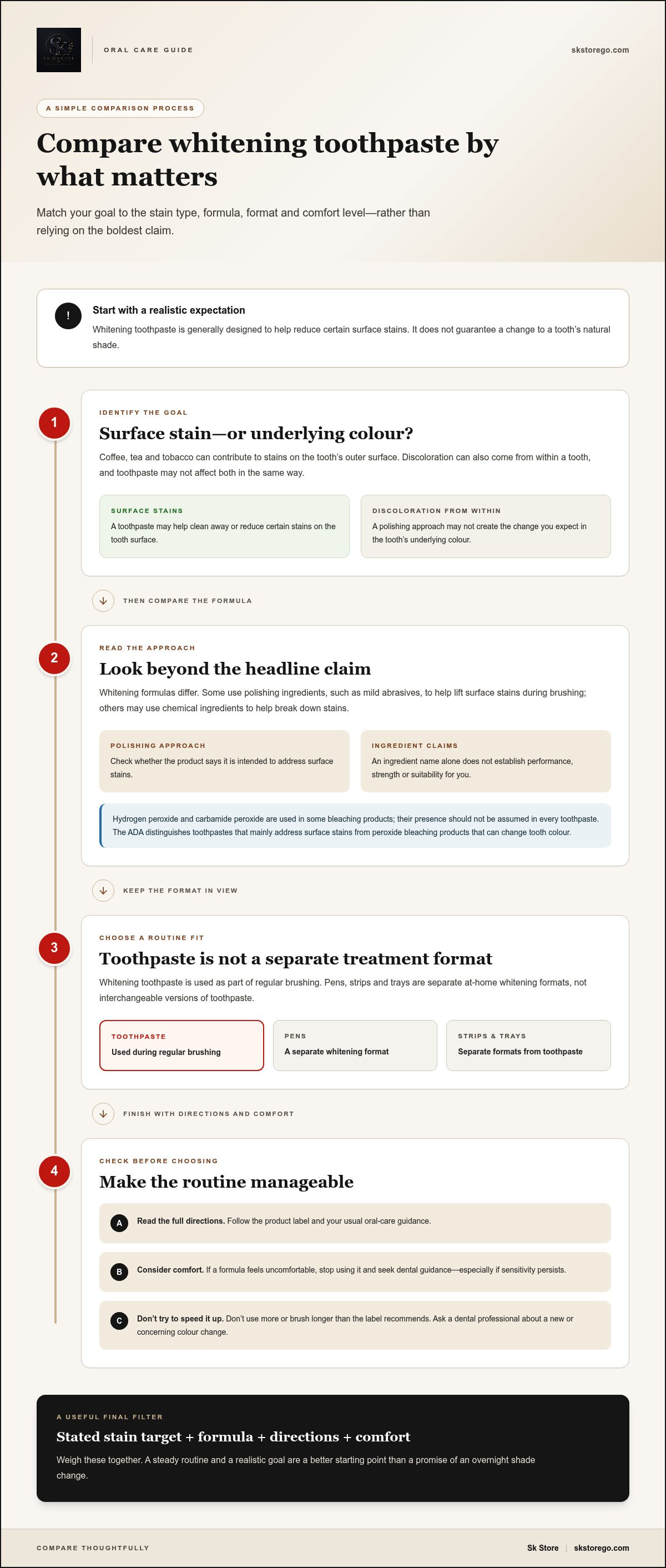
Use this checklist to choose a teeth whitening toothpaste
A quick, thoughtful comparison can make the choice simpler. Start with what you want from a product, then check that its stated purpose, directions, and everyday fit line up. Use these five steps to compare options without relying on a single bold claim.
- Define your goal. Decide whether you want a brighter-looking smile, fresh breath, or toothpaste for general daily brushing. These priorities can overlap, but they aren’t the same product claim.
- Note sensitivity. If your teeth are often sensitive, put comfort first and consider seeking dental guidance before choosing a whitening product.
- Compare claims. Read the exact product wording. Don’t assume every formula uses the same approach or targets the same concern.
- Check directions. Follow the product label. Avoid using multiple whitening products together unless a dental professional advises you to do so.
- Assess routine fit. Choose a format and brushing routine you can maintain comfortably, rather than using more product in pursuit of faster results.
Match your main goal to a product description
Use the comparison below to connect your priority with the wording and format on the product. Purple Teeth Whitening Toothpaste is described as a purple formula intended for daily brushing and a brighter-looking smile. UTOGRU Niacinamide Whitening Toothpaste is positioned around niacinamide and a fluoride-free formula. These details describe each product’s stated positioning, not a guaranteed result or a substitute for your own oral-care needs.
| Goal | Product type | Stated positioning | Questions to consider |
|---|---|---|---|
| A brighter-looking smile | Whitening toothpaste | Purple Teeth Whitening Toothpaste is a purple formula intended for daily brushing and a brighter-looking smile. | Does the product description match your expectations? Do the directions suit your brushing routine? |
| Compare an ingredient-led option | Whitening toothpaste | UTOGRU Niacinamide Whitening Toothpaste is positioned around niacinamide and is fluoride-free. | Does its stated positioning align with your everyday oral-care priorities? |
| Targeted touch-ups | Whitening pen | Sk Store’s pen is a mint gel product for targeted touch-ups. | Would a separately applied format fit your preferences and its directions? |
| Fresh breath or general brushing | Everyday toothpaste | Check the individual product description for its stated purpose. | Does the label address this goal, and does the formula fit your regular care needs? |
Avoid common shopping and use mistakes
Be cautious with promises of dramatic results or fixed timelines that don’t explain what the formula is intended to address. More frequent use doesn’t necessarily mean better results, and ignoring directions can make a product a poor fit. Stop using a product if discomfort persists, and seek advice from a dental professional. A dental professional is also the right source for personal concerns, ongoing sensitivity, or a noticeable change in tooth colour.
Ready to compare options against your priorities? Explore the curated selection and choose with your goal, comfort, and routine in mind.
Explore SK Store’s toothpaste options and choose your next step
Once you know what matters most, compare each toothpaste by its stated positioning rather than expecting every formula to work alike. Sk Store offers options with different descriptions, including niacinamide and fluoride-free positioning, and a purple formula intended for daily brushing. Use the details below as a starting point, then weigh them against your preferences and the directions on each product.
Which Sk Store toothpaste may fit your priority?
This comparison focuses on product descriptions, not rankings or promised results. Choose the option whose stated focus feels most relevant to the routine you want.
| Toothpaste | Supplied description | May suit readers who prioritize |
|---|---|---|
| UTOGRU Niacinamide Whitening Toothpaste | Niacinamide and fluoride-free positioning | Comparing a toothpaste by those stated features |
| Purple Teeth Whitening Toothpaste | A purple formula intended for daily brushing and a brighter-looking smile | A daily brushing formula positioned around a brighter-looking smile |
| Utogru Toothpaste | Described as supporting fresh breath and fighting plaque and cavities | Considering the product’s stated fresh-breath and general oral-care positioning |
These descriptions don’t establish that one option is clinically superior or right for everyone. In particular, fluoride-free positioning alone doesn’t show that a toothpaste offers cavity protection. If that matters to your daily care, consider the product’s full details and your individual oral-care needs as you compare. A teeth whitening toothpaste should fit both your expectations for appearance and the rest of your routine.
Make the choice part of a simple routine
After choosing, use the toothpaste consistently according to its directions and your usual oral-care guidance. Avoid adding extra brushing or combining whitening formats simply to chase a faster change. Sk Store also offers other at-home whitening formats, such as a mint gel pen for targeted touch-ups, but this guide focuses on toothpaste. Treat separate formats as distinct options, each with its own directions.
A comfortable, manageable routine is a sensible place to start. If you have ongoing sensitivity or a personal concern about your teeth, a dental professional can offer guidance tailored to you. Otherwise, compare the stated descriptions, check the directions, and choose the toothpaste that feels like the best fit for your preferences.
Ready to compare the options for yourself? Browse the AVADA Best Sellers collection and explore the toothpaste descriptions at your own pace.
Choose a routine that feels right for you
Your next step doesn’t need to be complicated. Pick the priority that matters most, then choose a teeth whitening toothpaste whose stated description fits your expectations and everyday preferences. The best fit is one you feel comfortable using as directed, without chasing a dramatic promise or adding unnecessary steps.
Sk Store’s selection includes toothpaste options with distinct descriptions, as well as other at-home whitening formats. Compare what each option says it’s designed for, then consider which format feels easiest to make part of your routine. Keep the choice simple and adjust your approach if your needs change.
Browse the AVADA Best Sellers collection to explore the options and find a comfortable place to start. A thoughtful choice, made at your own pace, can help make daily care feel more intentional.
Frequently Asked Questions
Does teeth whitening toothpaste actually whiten teeth?
It can make teeth look brighter if its formula helps reduce surface staining, but the effect depends on the product and what’s causing the discoloration. Think of it as a possible gradual change in appearance, not a guaranteed shade transformation. When comparing options, look for specific wording about the intended result and whether it fits your goal, rather than relying on a general “whitening” label alone.
Is teeth whitening toothpaste safe to use every day?
That depends on the specific toothpaste and its directions. Use it as the label instructs, and don’t assume a product is meant for more frequent brushing just because it’s sold as whitening toothpaste. If you rely on toothpaste for particular oral-care needs, such as cavity prevention, consider whether the formula suits those needs too. A dental professional can help with individual questions about your regular care.
Can whitening toothpaste cause tooth sensitivity?
It may contribute to discomfort for some people, although sensitivity can have more than one cause. Pay attention to how your teeth feel during use, especially if cold drinks or brushing become uncomfortable. If you notice persistent sensitivity, stop using the product and ask a dental professional for guidance. Avoid switching immediately to several other whitening products, since that can make it harder to tell what’s bothering you.
What ingredients should I look for in teeth whitening toothpaste?
Check the ingredient list alongside the product’s stated purpose. Some formulas use abrasives to polish surface stains, while some whitening products use peroxide ingredients. Potassium or arginine may appear in formulas aimed at sensitivity, but an ingredient name alone doesn’t establish how well a product will work or whether it suits you. Check whether the toothpaste meets your everyday oral-care preferences, too, rather than choosing based on whitening ingredients alone.
How long does teeth whitening toothpaste take to work?
There isn’t one reliable timeline for every formula or smile. Any visible change depends on the product, how consistently you use it according to directions, and the kind of staining involved. Avoid setting a deadline based on dramatic product claims or using extra toothpaste to speed things up. If you’re concerned about a lack of change or a new colour difference, a dental professional can help you understand possible next steps.
Is purple teeth whitening toothpaste different from regular toothpaste?
It can differ in colour and stated purpose. Purple colour-correcting formulas may make teeth appear less yellow temporarily by changing how colour is perceived, rather than bleaching the tooth. The effect and formula vary by product, so check the label for its intended use and directions. Sk Store describes Purple Teeth Whitening Toothpaste as a purple formula intended for daily brushing and a brighter-looking smile.
Can whitening toothpaste remove stains from coffee or tea?
It may help reduce some surface stains linked to coffee or tea if its formula is designed to polish those stains away. Results vary with the product and the staining, so don’t expect every mark to disappear or the tooth’s underlying colour to change. Keep brushing as directed, and consider how often these drinks are part of your routine when setting expectations for a product.
